FREE SAMPLES FEE -150+ Choices and Customization - REQUEST A QUOTE HERE

Understanding International Trade & Manufacturing Models
Explore the specific processes of international trade and learn about three key manufacturing models: OEM, ODM, and OBM. Analyze the strengths and weaknesses of international trade companies and factories to make informed decisions.
PROFESSIONAL KNOWLEDGE
Ava
9/20/20243 分钟阅读
In today's era of globalization, international trade is like a powerful torrent that is deeply reshaping the world economic landscape. With the rapid development of technology and the increasing openness of the market, international trade is expanding into new fields at an unprecedented speed and scale, bringing unprecedented opportunities and challenges to the world.
More and more people want to get a share of this pie, but do you know the specific process of doing foreign trade?




From the figure, it can be seen that choosing a trading company may provide some convenience in finding factories, but there are relatively more communication links; If choosing a factory without middleman, being able to communicate directly with the factory may result in lower quotes, more direct control over production progress, and more efficient communication and implementation of customized requirements.
Nowadays, factories are gradually undergoing transformation and upgrading. In this process, they not only continuously improve their own strength, but also gradually acquire professional foreign trade capabilities. The factory has established a specialized foreign trade department and provided professional training to its employees, enabling them to master the foreign trade process and efficiently handle various foreign trade businesses.
At the same time, factories actively cooperate with each other, and through this cooperation model, their resource networks become more diverse. On the one hand, due to factors such as economies of scale brought about by cooperation, product prices are relatively low and have strong market competitiveness; On the other hand, the factory always adheres to a dual focus on product quality and customer service. While ensuring high product quality, it provides customers with high-quality services and is committed to meeting their various needs to achieve sustainable development.
From the perspective of the manufacturing industry, there are three main models, namely OEM, ODM, and OBM. Factories play different roles in these three modes.


Three modes of manufacturing industry
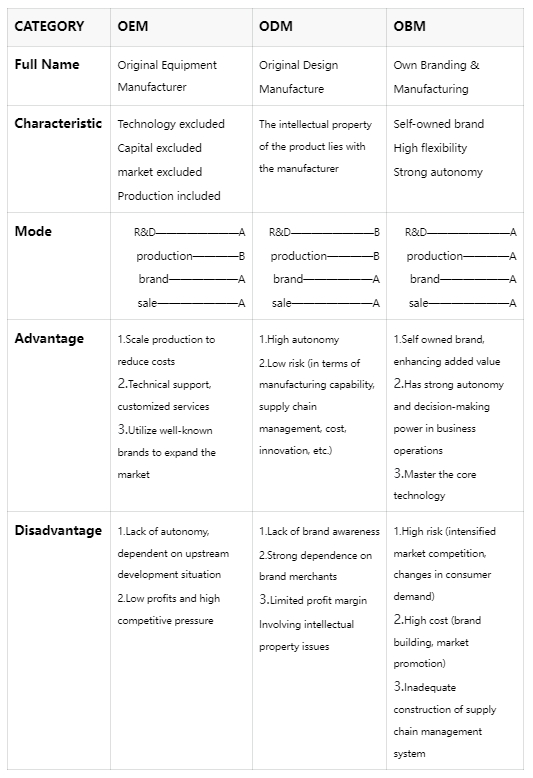
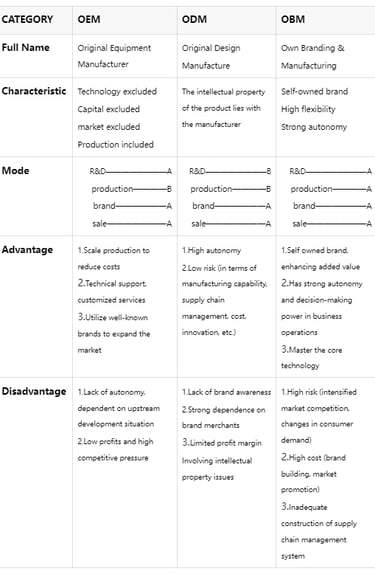
In OEM mode, the factory produces according to the design and specifications provided by the customer, and the technology and intellectual property usually belong to the customer, so the factory's autonomy is relatively low. In the cooperation between factories and foreign trade companies, factories may act as suppliers to foreign trade companies and produce according to their order requirements, similar to the operation of OEM.
In ODM mode, the factory is not only responsible for production, but also has certain design capabilities and can provide customized product design solutions for customers. In this mode, the technical strength and innovation capability of the factory are further reflected, and cooperation with foreign trade companies may also be closer, jointly exploring the market.
In the OBM mode, the factory has its own brand and has the full process capability from research and development, production to sales, with the strongest autonomy. This relationship with foreign trade companies may be more reflected in cooperation in brand promotion and market expansion.